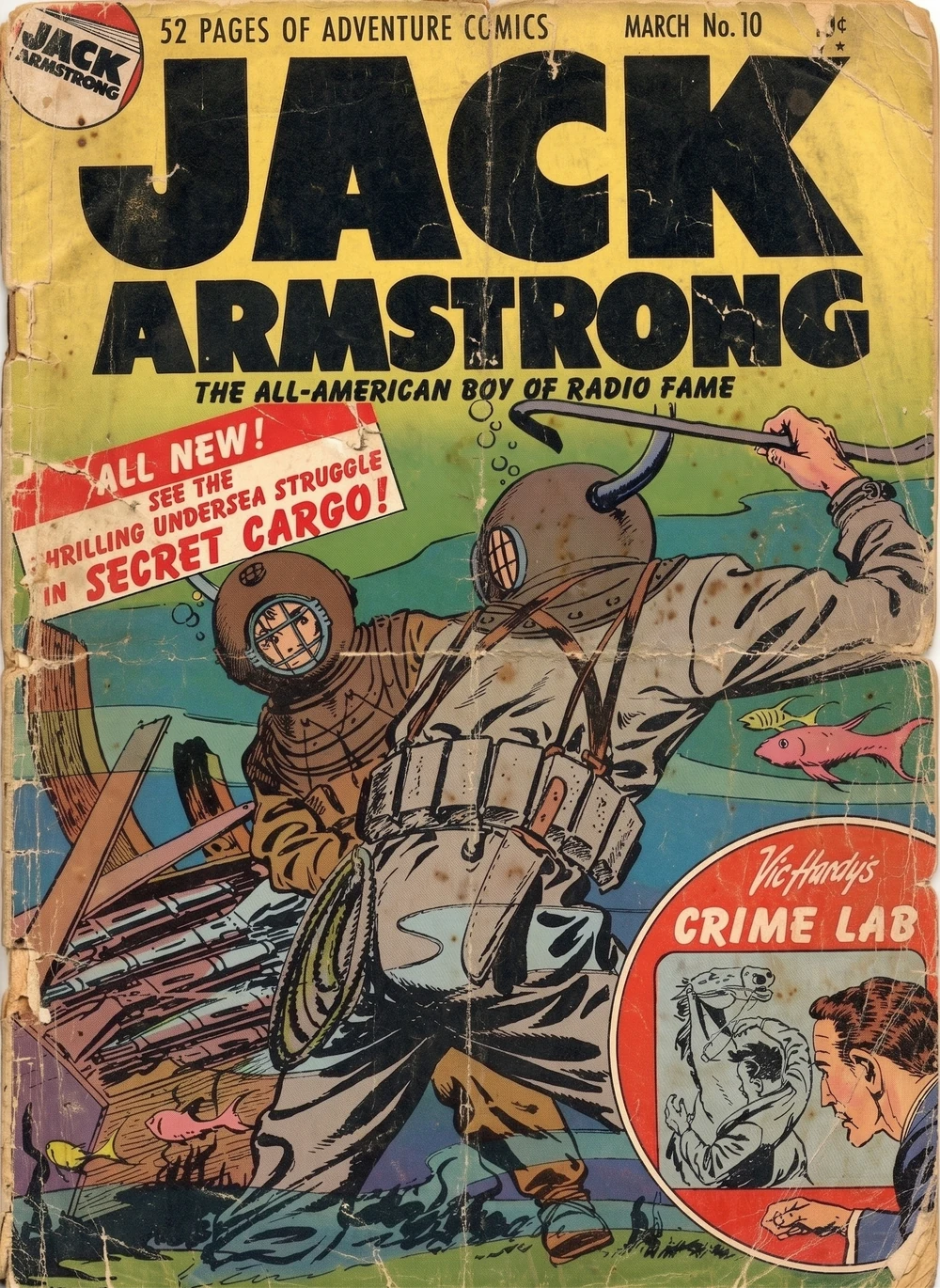
Jack Armstrong, The All-American Boy
Built to Sell Cereal, Built to Last
Jack Armstrong didn't start as a radio show — it started as a marketing idea. Samuel Chester Gale, Vice-President of Advertising at General Mills, wanted a fictional character who could persuade American kids to eat Wheaties. He was looking for an "everyboy," someone wholesome and athletic with a name that sounded like apple pie, and he found it in his own past: a fraternity brother from Phi Sigma Kappa at the University of Minnesota whose character and plain American sound had stuck with him. That name became Jack Armstrong, and on July 31, 1933, the show launched at WBBM in Chicago — a CBS affiliate — and was carried on the network for national broadcast.
The program was produced by the Chicago advertising agency Blackett-Sample-Hummert, the powerhouse operation run by Frank and Anne Hummert that was responsible for a significant chunk of daytime radio in the era. Original scripts came from writer Robert Hardy Andrews. The show aired at 5:30 p.m., Monday through Saturday, squarely in the children's hour. From the very first broadcast, Wheaties was the sole sponsor, and General Mills would stay in that chair for the entire eighteen-year run — one of the most committed single-sponsor relationships in radio history.
Jack, Billy, Betty, and the Silver Albatross
The premise was elegantly simple and endlessly flexible. Jack Armstrong, star athlete at Hudson High, traveled the world with his friends Billy Fairfield and Billy's sister Betty, under the care of their Uncle Jim Fairfield. Uncle Jim's cover for all the globe-trotting was his airplane factory business, which conveniently required travel to exotic corners of the earth and allowed him to bring three teenagers along. The group flew in Uncle Jim's hydroplane, the Silver Albatross, and landed in places like Morocco, Zanzibar, Easter Island, China, the Philippines, Nazi Germany, Tibet, and the Andes.
Writer Talbot Mundy joined the show in the spring of 1936 when he was in financial difficulty and stayed until his death in 1940, writing approximately 700 scripts. It was Mundy, according to radio historian Jim Harmon, who introduced Uncle Jim Fairfield as the group's adult mentor in the fall of 1936, giving the adventures a structure that would last the rest of the run. Mundy sent the characters to Egypt, Easter Island, India, Africa, and Tibet, and the stories functioned almost like a travelogue, packing in real facts about the places visited. The story lines themselves were built for sustained tension, left unresolved for months or even years, with kidnappings, rescues, mysteries, wars, and treachery threading through long serial arcs.
A Cast That Changed Constantly
With eighteen years on the air and a World War in the middle of them, Jack Armstrong went through more cast changes than most shows manage in half the time. The title role alone passed through Jim Ameche, Stanley Harris, Frank Behrens, Charles Flynn, Rye Billsbury, and St. John Terrell.
Jim Ameche was radio's original Jack Armstrong, holding the part from 1933 to 1938 and earning $59.50 a week for five broadcasts. He got the audition because his older brother — film star Don Ameche — made the call on his behalf. Don himself was the first actor to play Captain Hughes, the adult companion who joined the group on many of their adventures. Charles Flynn took over the title role in 1939 and, with one interruption for military service, held it through to the end of the series.
Billy Fairfield was played over the years by John Gannon, Roland Butterfield, Murray McLean, Milton Guion, and Dick York. York, who would later become famous as Darrin Stephens in TV's Bewitched, joined the cast around 1948 and stayed in the role until 1951; he also met his future wife, Joan Alt, during her appearance on the show. Betty Fairfield cycled through Shaindel Kalish, Sarajane Wells, Loretta Poynton, Naomi May, and Patricia Dunlap. Jim Goss played Uncle Jim Fairfield throughout. Among the announcers, Franklyn MacCormack was the best known — a "legendary Chicago voice" who delivered Wheaties commercials with the help of an a cappella quintet. The writing staff also included James Jewell, Lee Knopf, Irving Crump, and Col. Paschal Strong.
Box Tops and Premiums
The promotional machine built around Jack Armstrong was one of the most active in radio. Kids could send in a Wheaties box top and a dime and receive a Torpedo Flashlight, an Explorer Telescope, a Secret Bombsight, a Dragon's Eye Ring, a Rocket Chute, an Egyptian Whistling Ring, Tru-Flite model planes, or the Pedometer marketed as the Hike-O-Meter — which alone sold 1,200,000 units. The pipeline was designed to keep kids eating Wheaties and listening to the show, and it worked. This was the core logic of the whole enterprise: Gale's original bet — that a fictional All-American boy could move cereal — paid off consistently across nearly two decades.
The show's theme, "Wave the Flag for Hudson High, Boys," was performed by a vocal group called The Norsemen, and it became one of the most recognizable tunes in children's radio. The production drew on a deep bench of directors — David Owen, Pat Murphy, James Jewell, Ed Morse, and Ted MacMurray — and sound effects men including Harry Bubeck, Ed Joyce, Curt Mitchell, and Bob Graham.
Network Years and the Long Wind-Down
Radio historian Jim Ramsburg documents the network sequence as CBS from 1933 to 1936, NBC from 1936 to 1941, Mutual for roughly one season in 1941–42, and then the Blue Network — which became ABC — through the final broadcast on June 28, 1951. General Mills held the sponsorship through every one of those transitions.
For most of its radio life the show ran as a 15-minute daily serial. By 1947, as the daily serial format was losing favor with audiences, it shifted to a half-hour running two or three times a week. The final season brought the most significant change of all: Jack Armstrong graduated from high school, became a government agent for the Scientific Bureau of Investigation, and the show was renamed Armstrong of the SBI. Uncle Jim was phased out first, then Billy. Of the original trio, only Betty Fairfield was still in place when the run ended.
After Radio
Jack Armstrong made the jump to other media in ways that ranged from successful to almost-famous. Columbia Pictures released a 15-chapter movie serial in 1947, with John Hart — later known to television audiences as the Lone Ranger — in the title role. A newspaper comic strip drawn by Bob Schoenke ran from May 26, 1947 to June 11, 1950. And a Hanna-Barbera animated television pilot was developed around the character, but when negotiations for the rights collapsed the project was reworked into Jonny Quest, which premiered in 1964. Some Jack Armstrong footage reportedly survived in the closing credits of Jonny Quest.
The show was inducted into the National Radio Hall of Fame in 1989. Among the surviving episodes are multi-part story arcs including "Country of the Headhunters" and the "Sunken Reef Adventure," preserving stretches of the serialized storytelling that kept listeners coming back day after day. Ninety-four cataloged episodes survive from the broadcast run, with the earliest dating to December 31, 1935 and the latest to March 18, 1941 — a window into the show's middle years, when Talbot Mundy's globe-spanning scripts and the long-running serial format were operating at full strength.